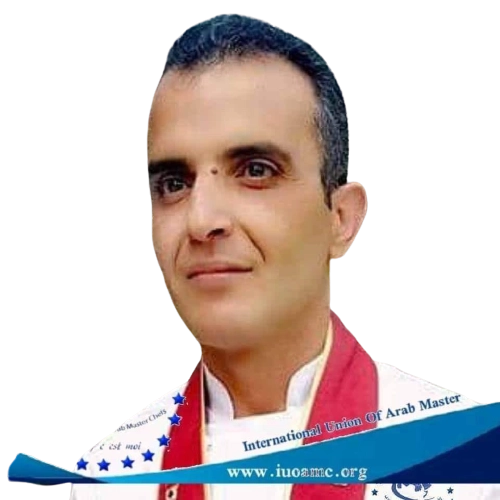
When Form Remains and Meaning Fades: On Professional Ethics and the Limits of Titles Ahmad Maadarani President of the International Union of Arab Master Chefs Expert in International Culinary & Gastronomy Arbitration
On Professional Ethics and the Limits of Titles
In the history of every profession, there comes an invisible moment—one that is not recorded in minutes, not captured in photographs, and not celebrated at conferences. It is the moment when meaning quietly begins to withdraw, while forms continue to advance with confidence. The crisis is not when a profession disappears, but when it remains visibly present after having lost its essence. When titles multiply, designations crowd the scene, and certificates accelerate, while the fundamental question fades: why did this profession exist in the first place, for whom, and under what responsibility?
Culinary arts, in their origin, were never a stage for appearance nor an arena for competing over the spotlight. They were a human act tied to time, accumulated experience, and the deep relationship between people and what they create with their hands. The profession was acquired slowly; patience was respected; and its value was measured by its ability to endure, not by its ability to impress. Yet the rapid transformations of the world, along with modern platforms of exposure, have pushed many professions—culinary arts among them—into a harsh test: can a profession keep pace with the era without losing its soul?
The problem does not begin when the new appears, but when depth is replaced by shortcuts. When the short path becomes the rule rather than the exception. When success is redefined by fast metrics that leave no room for genuine formation. In this context, the title shifted from being the outcome of a journey to becoming its entry point; from the culmination of experience to a marketing tool; from an ethical responsibility to a social access card. This transformation, though seemingly natural in an age of speed, carries a structural danger: stripping the profession of its ability to protect itself.
A title, in any sound professional system, is neither linguistic decoration nor a situational reward. It is an unwritten contract between its holder and the professional community—a contract that assumes the holder has followed a path, acquired experience, and become capable of bearing the consequences of decisions on others. When a title is granted outside this context, no single individual alone is wronged; rather, public trust in all standards is shaken. Because the professional community does not see individuals only, but what titles represent in meaning.
As titles inflate, a dangerous gray zone expands with them—a zone where no one is fully responsible and no one is clearly accountable. Who grants? Who oversees? Who bears the consequences of error? In this zone, the boundaries disappear between training and qualification, between learning and representation, between desire and readiness. Everything becomes linguistically possible but professionally fragile. The profession turns into an open space for individual improvisations rather than an agreed-upon system.
Education, in its essence, is an act of self-development. The learner expands horizons, sharpens tools, errs in order to correct. Professional status, however, is an act of influence over others. One who holds a status does not work only for themselves; they are seen as a reference point, a standard, a voice to be consulted. Confusing these two levels is not a linguistic issue but an ethical flaw. Granting status to someone unprepared to bear its impact places them in a position that protects neither them nor others.
In this context, judging emerges as one of the most sensitive domains. Judging is not a personal opinion, not an individual taste, and not a courtesy reward. It is an ethical practice before it is a technical one. Those who evaluate the work of others participate in shaping their professional paths, opening or closing doors, and reinforcing perceptions of justice or injustice. Any judging without framework, methodology, or documentation is inherently deficient, regardless of good intentions. Good intentions do not absolve responsibility, because the effect of decisions remains long after intentions are forgotten.
The painful paradox is that this rush toward shortcuts coincides with an unspoken exclusion of long experience. Chefs who built the profession under harsher conditions—who learned without platforms and served without audiences—suddenly find themselves outside the scene. Not because they lost value, but because they do not master the language of noise. A profession that excludes its memory loses its ability to learn. Experience is not merely skill, but memory of mistakes, awareness of limits, and deep understanding of what is not written in curricula.
Experience does not age; it is marginalized. The difference is profound. When experience is marginalized, not only its holders lose, but the next generation loses the opportunity to learn from real paths. History becomes a burden instead of an asset. The wheel is reinvented again and again—with the same mistakes under new names. This endless rotation is one of the symptoms of the absence of a system.
A system, in its deeper meaning, is neither authority nor administrative structure. It is an unspoken ethical agreement about what is acceptable and what is not. It is a network of standards that protects the profession from individual whims and provides common ground for disagreement without chaos. A system need not be loud or imposed by force; it only needs to be clear. Clarity is the harshest test of any undisciplined practice.
When standards are written, claims become costly. When methodology is known, shortcuts are exposed. When responsibility is defined, recklessness recedes automatically. The most dangerous thing for any profession is to remain without a framework, because emptiness never stays empty—it is filled by what is easier, not by what is right.
This text is not written out of nostalgia for the past, nor rejection of development, nor fear of the new. It is written from the conviction that true progress is not measured by the speed of change, but by a profession’s ability to preserve its essence while evolving. Modernity that devours ethics is not progress; it is merely a change of surface. A profession that forgets why it exists, no matter how much it expands, loses its meaning.
In moments of major transition, professions do not need more voices, but a collective moment of silence in which the essential question is asked again: what do we want to pass on? More titles, or clearer meaning? Louder noise, or a sturdier system? Future generations will not judge us by what we said, but by what we left functioning after we exit the scene.
Continuity is the true test of any system: to operate without names, slogans, or constant self-defense. When rules are stronger than individuals and standards clearer than rhetoric, the profession can breathe safely. Only then does difference become healthy, diversity a source of strength, and progress possible without being destructive.
The future does not need more promises. It needs honest, calm texts that can be read years later without sounding outdated. It needs systems that think beyond their founders. It needs the ethical courage to say: we are not the center of the story, but a link within it—and what we leave behind matters more than what we raise before us.
For the gravest threat to a profession is not open chaos, but chaos disguised as general acceptance—when everything becomes acceptable under the banner of openness, every practice justified in the name of development, and every shortcut tolerated as realism. At that precise moment, the problem is no longer weak practices, but the collective inability to name them as such. Silence here is not wisdom; it becomes indirect participation in erosion.
Professions that lack the courage to face themselves gradually lose the ability to protect their weakest links. When links weaken, systems do not collapse suddenly; they bend until any additional pressure suffices to break them. This is what happens when standards remain vague and are replaced by intention, fame, or numbers. Numbers do not create legitimacy, reach does not build reference, and good intention does not compensate for the absence of framework.
Amid this landscape arises an uncomfortable question: who benefits from the absence of clarity? Usually not the beginner, not the experienced, and not the profession itself. The true beneficiary is chaos, because it allows everything to appear acceptable and every voice to claim representation. When representation has no conditions, the profession becomes a symbolic battleground rather than an organized field of work.
Regulation is not meant to restrict creativity, suffocate initiatives, or close doors to the new. On the contrary, real regulation allows creativity to have meaning. Creativity that is not measured, discussed, or contextualized becomes a fleeting event. Creativity placed within a path, compared against a standard, and read in context accumulates impact. The difference between the two is the difference between what is forgotten and what is built upon.
Many confuse professional freedom with professional chaos. Freedom means choosing within a clear framework; chaos means everything is permissible without accountability. Historically, free professions were not rule-less; they were the strictest in standards, because they understood that freedom without responsibility quickly becomes a burden. This applies to culinary arts as it does to any professional field.
When responsibility disappears, success is redefined superficially: success becomes appearance rather than continuity, speed rather than accumulation, reaction rather than deep action. This kind of success is inherently fragile because it cannot withstand time. Time is the first enemy of everything built on shortcuts and the sole ally of what is built on patience. Professions that fear time try to outrun it—but only postpone confrontation.
One of the most dangerous consequences of this acceleration is turning professional symbols into consumable icons. What once resulted from a long path becomes a tradable image, stripped of context and quickly consumed. With repeated consumption, symbols lose their inspirational power and become professional décor. This weakens not only individuals but the shared language of the profession itself.
Professional language is not mere terminology; it is an implicit agreement on meaning. When terms are emptied of meaning, they lose function. When terms mix, roles mix. When roles mix, responsibilities vanish. Protecting professional language is therefore an essential part of protecting the profession. Disciplined language is not a luxury; it is an ethical and organizational necessity.
Without this discipline, every objection becomes an attack, every question suspicion, and every attempt at organization exclusion. Concepts are inverted until those who demand standards appear enemies of openness, and those who call for responsibility obstacles to progress. This paradox is one of the most dangerous symptoms of transitional phases, creating an atmosphere where silence is preferred over questioning, courtesy over evaluation, and withdrawal over calm confrontation.
Yet professions are not built by courtesy. They are built by their ability to contain difference within clear rules. Healthy difference needs common ground. Without it, difference turns into personal conflict or silent parallelism that produces neither knowledge nor progress. A real system does not abolish difference; it organizes it. It does not block plurality; it gives it meaning.
When we speak of future generations, we speak not of unknown individuals, but of the direct outcome of what we do today. The next generation will treat what we leave as a starting point, not a debate. If they inherit clarity, they will differ within it; if they inherit chaos, they will either be lost in it or reproduce it. We cannot burden them with correcting what we failed to name.
Writing at this stage is therefore not an intellectual luxury but an act of responsibility—not to record a stance, but to anchor meaning. Texts written calmly, without haste or desire to win, are the only ones capable of crossing time. Time does not preserve shouting; it preserves what can be returned to.
This text offers no ready technical solutions nor detailed regulatory recipes. Solutions change with context; principles endure. What is offered here is a call to restore the obvious truths that lost clarity under the pressure of speed—a call to rebuild the healthy relationship between title and responsibility, experience and representation, education and influence.
When this relationship is restored, problems do not vanish, but they become manageable. The difference between crisis and chaos is framework. Crises can be addressed; chaos consumes every attempt at reform. A system does not prevent error, but it prevents error from becoming the rule.
What professions need most today are not more heroes, but more guardians—guardians of meaning, not of positions. The guardian need not stand at the front; vigilance suffices. Applause is unnecessary; inner clarity is enough. This kind of guardianship makes the long-term difference, even if invisible in the moment.
History shows that the most prosperous periods of any profession were not those crowded with names, but those that solidified rules. Names come and go; good rules remain. What remains is what deserves effort.
The future, ultimately, is not an abstract idea. It is the accumulation of small decisions, daily choices, and deliberate silence at the right moment. Not every generation must be revolutionary, but every generation must be honest—professionally as well as ethically. To leave the profession better than it was found, or at least clearer.
Clarity is not achieved by eliminating others, criminalizing them, or belittling them. It is achieved by offering a calm, coherent alternative—one that does not impose itself by force but by the gravity of its logic. When methodology outweighs claim and standard outweighs rhetoric, people naturally choose what protects them in the long run.
At the end of this path, the question is no longer: who won? But: what remains? What can be read years later without explanation? What can function without being tied to a name? What can operate without constant defense?
This is the true test of any sincere professional effort: that it becomes independent of its author, part of the structure rather than the façade—invoked when needed without self-announcement. When a system reaches this stage, its creator can step back, assured that what was left can endure.
Professions do not need saviors. They need those who understand the limits of their role—who know when to advance and when to simply place the right stone in the right place. One correct stone in the correct place is worth more than a thousand movements in the wrong direction.
Thus the final question of any serious professional journey is not: what did I achieve? nor: how often was my name mentioned? but a simpler, harsher one: if I disappear tomorrow, will what was built collapse—or continue without my name? This silent question is the true scale of seriousness. What needs its owner to stay alive was never complete; what can function without them alone deserves to be called impact.